Sunday, April 26, 2020

Station of the Cross ( Via Crucis )

Via Crucis (Stations of the Cross or the Way of the Cross), refers to 14 images depicting Jesus Christ on the day of his crucifixion and accompanying prayers. The stations grew out of imitations of Via Dolorosa in Jerusalem which is believed to be the actual path Jesus walked to Mount Calvary.

Commonly, the 14 images will be arranged in numbered order along a path and the faithful travel from image to image, in order, stopping at each station to say the selected prayers and reflections. This will be done individually or in a procession most commonly during Lent, especially on Good Friday, in a spirit of reparation for the sufferings and insults that Jesus endured during his passion.

It has become one of the most popular devotions and the stations can be found in many Western Christian churches, including Anglican, Lutheran, Methodist, and Roman Catholic.


Station 1 – Jesus is Condemned to Death
( Matthew 27:27:11-26, Mark 15:1-15, Luke 23-1-25, John 18:28-19:16 )

Station 2 – Jesus Carries His Cross
( Matthew 27:27:27-31, Mark 15:20, John 19:17 )

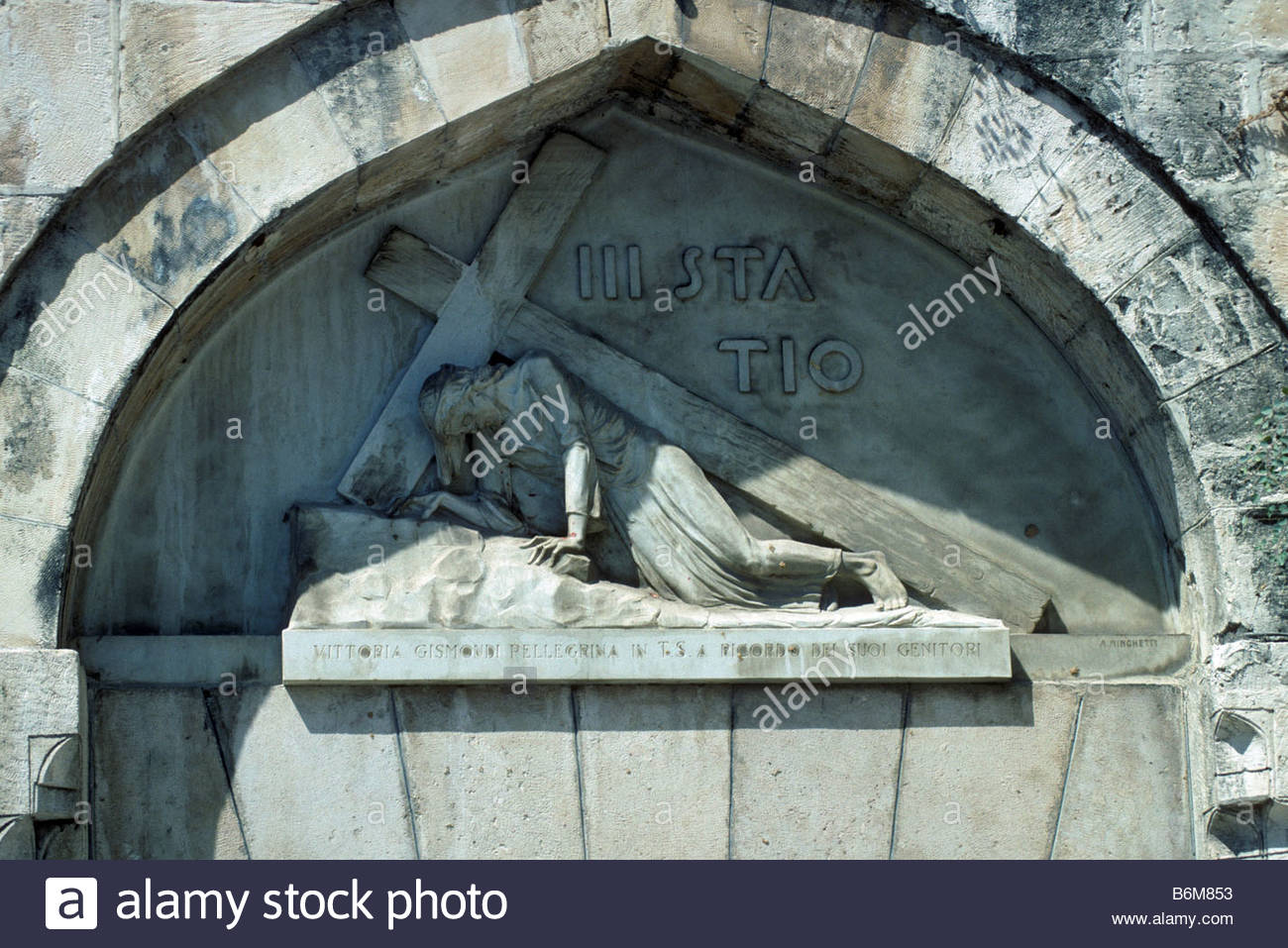
Station 3 – Jesus Falls the First Time

Station 4 – Jesus Meets His Mother

Station 5 – Simon of Cyrene Helps Jesus Carry the Cross
( Matthew 27:32, Mark 15:21, Luke 23:26 )

Station 6 – Veronica Wipes the Face of Jesus

Station 7 – Jesus Falls the Second Time

Station 8 – Jesus Meets the Women of Jerusalem
( Luke 23:27 )

Station 9 – Jesus Falls the Third Time

Station 10 – Jesus is Stripped of His Garments
( Matthew 27:35, Mark 15:24, Luke 23:34, John 19:23 )

Station 11 – Jesus is Nailed to the Cross
( Matthew 27:35, Mark 15:25, Luke 23:33, John 19:23  )

Station 12 – Jesus Dies on the Cross
( Matthew 27:50, Mark 15:37, Luke 23:46, John 19:30 )
Station 13 – Jesus is Taken Down from the Cross

Station 14 – Jesus is Laid in the Tomb
( Matthew 27:57-60, Mark 42-46, Luke 23:50-53, John 19:38-41 )


Via Dolorosa ( Way of Suffering )


The Via Dolorosa (Way of Suffering‎) is a processional route in the Old City of Jerusalem, believed to be the path that Jesus walked on the way to his crucifixion. The 600 m winding route starts from the former Antonia Fortress and ends at the Church of the Holy Sepulchre.

The current route has been established since the 18th century, replacing various earlier versions.   It is today marked by 9 Stations of the Cross.


Station 1 – Jesus is Condemned to Death
( Matthew 27:27:11-26, Mark 15:1-15, Luke 23-1-25, John 18:28-19:16 )

Station 2 – Jesus Carries His Cross
( Matthew 27:27:27-31, Mark 15:20, John 19:17 )
 

Station 3 – Jesus Falls the First Time

Station 4 – Jesus Meets His Mother

Station 5 – Simon of Cyrene Helps Jesus Carry the Cross
( Matthew 27:32, Mark 15:21, Luke 23:26 )

Station 6 – Veronica Wipes the Face of Jesus

Station 7 – Jesus Falls the Second Time

Station 8 – Jesus Meets the Women of Jerusalem
( Luke 23:27 )

Station 9 – Jesus Falls the Third Time

Station 10 – Jesus is Stripped of His Garments
( Matthew 27:35, Mark 15:24, Luke 23:34, John 19:23 )

Station 11 – Jesus is Nailed to the Cross
( Matthew 27:35, Mark 15:25, Luke 23:33, John 19:23  )
 Station 12 – Jesus Dies on the Cross
( Matthew 27:50, Mark 15:37, Luke 23:46, John 19:30 )

Station 13 – Stone of the Anointing
 ( John 19:39-40 )

Station 14 – Jesus is Laid in the Tomb
( Matthew 27:57-60, Mark 42-46, Luke 23:50-53, John 19:38-41 )


Church of the Holy Sepulchre (335 AD)


Church of the Holy Sepulchre, is built on the traditional site of Jesus’ Crucifixion and burial. According to the Bible, his tomb was close to the place of the Crucifixion (John 19:41–42), and so the church was planned to enclose the site of both the cross and the tomb.

Both Calvary ( Golgotha ) and the Tomb of Christ were isolated by cutting away the surrounding rock and earth, making them free-standing blocks.

Within the church proper are the last 5 stations of the Via Dolorosa, representing the final episodes of the Passion of Jesus.


Brief History


In 312 AD, after Constantine the Great converted to Christianity, he sent his mother Helena to Jerusalem to look for Christ’s Tomb.  
Helena found 3 crosses near to a tomb, which believed to be the Calvary and Christ’s Tomb.

A church was constructed over the two sites : an enclosed colonnaded atrium with the Calvary in one corner, and a rotunda called Anastasis where Jesus have been buried.  The Church was consecrated on 13th September 335.

Since then, the church underwent many damages and rebuilding.  It was destroyed by the Persian, damaged in earthquakes and fires.  Restorations and reconstruction were carried out by Emperor Heraclius, and Patriach Thomas.  Despite being captured by the Muslims, it remained a Christian church. 

On 18th October 1009,  Fatimid Caliph Al-Hakim bi-Amr Allah ordered the complete destruction of the Church.  In 1048, after given permission by the Muslilms, it was rebuilt by Byzantine emperor Constantine IX Monomachus, but on a different plan, with the entrance on the south side. 


Jerusalem was captured by the Christians during the First Crusade (1096-1099).  The Church was restored and all the small chapels were placed under one roof. It was reconsecrated on 15th July 1149.

Over 3 centuries, the Church has been changing hand between the Crusaders and the Muslims, till Jerusalem fell to the hands of the Ottoman Empire.


Calvary

Inside the church entrance is a stairway leading up to Calvary (Golgotha), the most lavishly decorated part of the church.

Calvary is split into two chapels, one Greek Orthodox and one Catholic, each with its own altar. On the left (north) side, the Greek Orthodox chapel's altar is placed over the rock of Calvary. The rock can be seen under protective glass on both sides of the altar. The softer surrounding stone was removed when the church was built.
 
On the ground floor, just underneath the Golgotha chapel, is the Chapel of Adam.  According to tradition, Jesus was crucified over the place where Adam's skull was buried.

Behind the Chapel of Adam is the Museum of the Greek Orthodox Patriarchate, which holds many relics, including a 12th-century crystal mitre alleged to have once held a fragment of the Holy Cross.


Stone of Anointing

The Stone of Anointing, where Jesus' body is said to have been anointed before burial.

Just inside the entrance to the church is the Stone of Anointing, which tradition believes to be where Jesus' body was prepared for burial by Joseph of Arimathea.


Christ’s Tomb

In the centre of the rotunda is a small chapel which encloses the Holy Sepulchre. The Chapel holds the Angel's Stone, which is believed to be a fragment of the large stone that sealed the tomb; and the tomb of Jesus.

West of the Chapel is the Chapel with Tomb of Joseph of Arimathea.


Debate

This site has been continuously recognized since the 4th century as the place where Jesus died, was buried, and rose from the dead.

Whether it is the actual location, however, has been hotly debated. It cannot be determined that Christians during the first 3 centuries could or did preserve an authentic tradition as to where these events occurred.

Members of the Christian church in Jerusalem fled to Pella about 66 AD, and Jerusalem was destroyed in 70 AD.

Wars, destruction, and confusion during the following centuries possibly prevented preservation of exact information.

Another question involves the course of the second north wall of ancient Jerusalem. Some archaeological remains on the east and south sides of the Church of the Holy Sepulchre are widely interpreted to mark the course of the second wall. If so, the site of the church lay just outside the city wall in the time of Jesus, and this could be the actual place of his Crucifixion and burial. No rival site is supported by any real evidence.


Friday, April 24, 2020

主祷文(加长版) 祈求就給你們 - an OmgziVersion


耶穌在一個地方禱告;禱告完了,有個門徒對他說:"求主教導我們禱告,像約翰教導他的門徒 (路加福音11:1)

你們禱告的時候,不可像那假冒為善的人,愛站在會堂裡和十字路口上禱告,故意叫人看見。我實在告訴你們,他們已經得了他們的賞賜。你禱告的時候,要進你的內屋,關上門,禱告你在暗中的父;你父在暗中察看,必然報答你。你們禱告,不可像外邦人,用許多重複話,他們以為話多了必蒙垂聽。你們不可效法他們;因為你們沒有祈求以先,你們所需用的,你們的父早已知道了(馬太福音 6:5-8)

耶穌說:你們禱告的時候,要說:
我們在天上的父:願人都尊你的名為聖。願你的國降臨;願你的旨意行在地上,如同行在天上。我們日用的飲食,天天賜給我們。赦免我們的罪,因為我們也赦免凡虧欠我們的人。不叫我們遇見試探;救我們脫離兇惡"(路加福音2-4) (馬太福音 6:6-13) 因為國度、權柄、榮耀,全是你的,直到永遠。阿們。”(馬太福音 13b)

耶穌又說:你們中間誰有一個朋友半夜到他那裡去,說:朋友!請借給我三個餅;因為我有一個朋友行路,來到我這裡,我沒有甚麼給他擺上。那人在裡面回答說:不要攪擾我,門已經關閉,孩子們也同我在床上了,我不能起來給你’” (路加福音11:5-7)

我告訴你們,雖不因他是朋友起來給他,但因他情詞迫切的直求,就必起來照他所需用的給他(路加福音11:8)

我又告訴你們,你們祈求,就給你們尋找,就尋見;叩門,就給你們開門。因為,凡祈求的,就得著;尋找的就尋見;叩門的,就給他開門。你們中間作父親的,誰有兒子求餅,反給他石頭呢?求魚,反拿蛇當魚給他呢?求雞蛋,反給他蠍子呢?你們雖然不好,尚且知道拿好東西給兒女;何況天父,豈不更將聖靈給求他的人麼(路加福音11:9-11)(馬太福音7:8-11)

你们不要求吃什么,喝什么,也不要挂虑。这都是世上的外邦人所求的;你们需要这些东西,你们的父都知道。你们只要求他的国,这些东西就必加给你们了(路加福音 12:29-31)


Tuesday, April 21, 2020

Church of Holy Mary of Grace (1482)


Santa Maria delle Grazie ("Holy Mary of Grace") is a church and Dominican convent in Milan.   

This historic building is located in the very Piazza Santa Maria delle Grazie and Corso Magenta, in the historic center of Milan. 

The church has seven chapels square on each side.    The most important families of Milan sought to sponsor each chapel in exchange for use as a their family burial place. 


Brief History

The construction of the church and convent  complex was ordered by  Duke of Milan Francesco I Sforza in 1463, with Guiniforte Solari as the architect.  Construction of convent completed in 1469, the church in 1482.


Donato Bramante made a great expansion of the structure, adding large semicircular apses, a majestic dome surrounded by columns, a beautiful cloister and the refectory.

The building was restored 4 times: in 1908, 1924, 1953 ( post WW2 ) and 1977.


Renaissance Art

Despite its great architectural value, the complex houses invaluable work of arts of the renaissance period.

In 1543, the Titian altarpiece depicting Christ receiving the crown of thorns was installed in the Chapel of the Holy Crown, located on the right of the nave. The painting, looted by French troops in 1797, is now in the Louvre.

This chapel is frescoed with Stories of the Passion by Gaudenzio Ferrari. In the small cloister adjacent to the tribune near the door that leads to the sacristy is a fresco by Bramantino.


The church also contained frescoes depicting the Resurrection and Passion by Bernardo Zenale


Perhaps  the most  famous of all is the work by  Leonardo Da Vinci, a fresco of  The Last Supper, preserved inside its refectory, painted between 1495 – 1498.


Sunday, April 19, 2020

Church of Saint Mary in Cosmedin (1123)


Santa Maria in Cosmedin is the Oriental Rite church for Catholics of the Melkite rite.  It is the second church in Rome to be dedicated to the Blessed Virgin Mary.

It is located at Piazza della Bocca della Verità.

The church is one of the most important Roman basilicas, standing as a symbol of the city itself,
and constitutes - with the adjacent temples of Piazza Bocca della Verità : Temple of Hercules Victor ( c200 AD ), the Temple of Portunus ( c300 AD ),  the Arch of Janus ( c 400 AD ), Arcus Argentariorum ( 204 AD ),  and the Fontan dei Tritooni ( 1715 ).


History

The Basilica of S. Maria in Cosmedin rises in the Forum Boarium.

The actual foundation of the church is undocumented. It may be very early, of the 3rd century, but the extant tradition mentions it as having been built by Pope Gregory the Great at the end of the 6th century.

It was built over the remains of the Templum Herculis Pompeiani in the Forum Boarium and of the Statio annonae, one of the food distribution centers of ancient Rome. Remains of the pavement survive in the crypt and behind the church.

The church was rebuilt by Pope Adrian I in 782, and granted to Greek monks from Constantinople exiled by the iconoclast persecutions in the Byzantine Empire.

The church was originally known as Santa Maria in Schola Graeca (Our Lady at the Greek Confraternity).   Because of its beauty, the Greek monks gave the church the adjective Cosmedin (from Greek kosmidion), beautiful, a reference to the rich ornamented by Pope Hadrian.

The church suffered a major earthquake in 847. So, later in the 9th century, Pope Nicholas I ordered a restoration which included a sacristy, a papal palace and a new chapel dedicated to St Nicholas. These additions were destroyed when the complex was damaged during the Sack of Rome in 1084 led by Robert Guiscard.


The subsequent restoration of 1123, ordered by Pope Callistus II and carried out by Cardinal Alfanus, who added the portico, red-brick Romanesque campanile and the beautiful Cosmatesque style decorations inside, resulting in the building that we have today. The restoration also entailed the removal of the galleries, the building of the schola cantorum and the arcades for the aisles. The walls were covered with frescoes, of which fragments survive.

The church was given to the Benedictines of Monte Cassino in 1432 by Pope Eugenius IV, but in
1573 it became a secular canonry again.

Pope Clement XI, in 1715, had the piazza lowered it to corresponded to the level of the floor of the church, and reorganized the entire neighborhood by rearranging the area, which had become rundown. The pontiff had the Fontana dei Tritoni erected, a Baroque work by Carlo Bizzaccheri.


In 1718 the church was brought up to a Baroque style, mainly expressed by a new façade and vaulted ceiling, by Giuseppe Sardi in 1718.   The Baroque additions, however, were removed in the restoration of 1894-1899, together with the coat-of-arms of Pope Clement XI who had sponsored Sardi's work, by the architect Giovanni Battista Giovenale. This included restoring the ceiling and mediaeval appearing portico and facade. Also, the side apse chapels of the Madonna di Loreto and that of San Giovanni Battista were restored and decorated with Romanesque style frescoes by Cesare Caroselli with the assistance of Alessandro Palombi.

There was a restoration of the façade and campanile in 1964, and also a further recent restoration to the sacristy block.

Exterior

The ancient church Santa Maria in Cosmedin rises on the east side of Piazza Bocca della Verita.  The square lies in the ancient Forum Boarium, formed by the depression among the three hills on which Rome was built (the Palatine, the Aventine and the Capitoline).


Campanile ( 1123 )
This is one of the finest mediaeval Romanesque campaniles in Rome.  It  is the earliest documented campanile in Rome, built around the year 1123. It is unusually tall, 34.2 meters, in brick and having nine storeys.

Façade
The modern façade was rebuilt in 1899 in a presumed mediaeval style.

Portico
The most famous part of the church is found in the portico. The Bocca della Verità, 'Mouth of Truth', can be found at the left end. It is an ancient well-head or drain cover of the ancient Cloaca Massima in the shape of a mask, placed here in 1632. 


Interior

Nave
The original 8th century church had trabeated colonnades instead of arcades.  

The nave is lighted by rows of small arched windows below the roofline, twenty seven in all. 


Cosmatesque Mosaics ( 1123 )
This church owns many floors of cosmati style. The cosmati style is an old artistic kind which composed with Sierpinski’s triangle which can be dated back to as old as 9th century. The Sierpinski's triangle is used differently to made some paterns.


Counterfaçade
On either side of the entrance door are black granite stones. They are standardized Roman weights. In pre-Christian times, such weights were kept in the temples were they could be used to check the weights used by merchants. When Rome became a Christian city, they were moved to the churches.

  Schola cantorum
The schola cantorum (choir) is a precious mediaeval survival, being an enclosure for the singers of the liturgy; there is another at San Clemente.


Side chapels

Baptistery
The first chapel on the left hand aisle is the baptistery, which was fitted out by Cardinal Annibale Albani in 1727 and painted by Giacomo Triga.

 Chapel of San Giovanni Battista de’Rossi
The second is the Chapel of San Giovanni Battista de’Rossi, with an altarpiece of the saint on the 18th-century altar and a bronze balustrade also from the 18th-century.  

On the altar is kept the alleged skull of St Valentine.


 Chapel of the Crucifixion
The third side chapel on the left hand aisle is of the Crucifixion, and the fittings were provided by Giovanale. Here is a fine tabernacle in polychrome marble from 1727.

 Chapel of Our Lady of Loreto
The left hand apse chapel at the end of the aisle is dedicated to Our Lady of Loreto.   The 19th century frescoes of Caroselli an Palombi, show the Birth of Our Lady on the left, and her death on the right. In the conch she is shown in a mandorla holding the Christ Child, in front of the Holy House which tradition declared was taken by angels from Nazareth to Loreto. The modern altar is a slab on a short column, in the mediaeval style.

 Chapel of St. John the Baptist
The apse chapel at the end of the right hand aisle has the same design of windows and altar, and is dedicated to St John the Baptist. The 19th century frescoes, also by Caroselli and Palombi, depict scenes from his life.

 Sacristy
Access to the sacristy is from the right aisle. An 8th century mosaic fragment of the Adoration of the Magi is displayed over the altar in the sacristy. It was originally in Chapel of the Virgin in old St Peter's, and was executed under Pope John VII about the year 705, and transferred here in 1639. A precious survival, it is artistically interesting in that it owes more to the original Classical style of painting than to the Byzantine one. The picture of the altar is by Maniardi, the laterals by Giuseppe Chiari from Genoa. The sacristy is now the church's shop.


 Winter Choir
Adjoining the right aisle is the winter choir, designed by Tommaso Mattei on the commission of
Canon Giovanni Battista Sabatini, which was completed by 1687.  

 Crypt
The crypt, built by Pope Hadrian in the 8th century.  The crypt itself is a miniature basilica with six columns, three on each side. The columns have no bases and derivative Composite capitals with simplified acanthus leaves.

At the far end is the original altar of Hercules. The altar, brought here by Pope Hadrian I and later dedicated by Pope Callixtus to Saint Cyrilla,